Busra Waterfall(M. Kiri)

Bu
sra Waterfall is located in Pich Chenda district about 43 kilometers northeast of Mondulkiri provincial town, Sen Monorom. Busra is considered by many to be the most beautiful waterfall in Mondulkiri. The waterall is divided into three stages:

  1. First Stage: The waterfall fall is 8 to 12 meters high and 15 meters wide in rainy season and 10 to 15 meters in dry season.
  2. Second Stage: The waterfall fall is 15 to 20 meters high and 20 meters wide in rainy season and 18 to 25 meters high and 13 meters wide in dry season. The second stage is 150 meters from the first stage.
  3. Third Stage: The speed of waterfall is faster than the second stage. This stage cannot be reached because it is in the thick forest. There are no marked paths and dangerous wildlife inhabits the area.

Busra Waterfall is the most popular place in Mondul Kiri province. It is arounded by the beautiful forest and a lot of wide animals live there. Busra is the natural waterfall place that many people would like to visit there when they have free time, holiday, study research, and family relax. When the visitor arrived there, first they would like to get lunch near the water flow and then they like to stand under the waterfall, it is so fantastic and feel so cool to the their heart. When the khmer ceremonies come, expecialy Khmer new year and Pchum Ben, there are lots of national visitor and international visitor go to visit there.


Banteay Chhmar Temple(B. Meanchey)

Banteay Chhmar temple is a historical site located in Thmor Pouk district along National Road 69A, a bout 59 km north of the provincial town. A temple was built in the 12th and 13th centuries, during the reign of king Jayavarman VII. But years of the war have laid waste to the temple, and thieves and villagers have removed the statues and sculptures for sale in Thailand.

There are other temples in Banteay Meanchey province besides the Banteay Chhmar temple, including Banteay Toap, Preah Chhor and Pram temples.These temples, however, have not been conserved. Today, Banteay Chhmar temple is an important site in Banteay Meanchey province in the development of international tourism.

River Front

A stroll or cyclo ride along the park lined riverfront is a must-- pubs, restaurants, shops and tourist boats line the way.

Chhroy Changva park is another newly attraction at the other side of the river opposite the Royal Palace.
The view of the confluence of the Mekong and the Tonle Sap is geopraphically unique.
Early risers, check out the paectacular sunrse over the river in front of the Royal Place.

National Museum

National Museum of Phnom Penh is instantly recognizable, with its warm red terracotta and its gracefully curved roof topped by dozens of guardian nagas. Located just north of the Royal Palace, off the street of Artists (178 Street), it was designed in 1917 by famed French architct George Groslier and the Ecole des Arts Cambodgiens, who made the most of traditional Khmer style. It was inaugurated by king Sisowath in 1920.

Worth visiting for its beauty alone, the National Museum also houses the world's foremost collection of ancient Khmer archaeological, religious and artistic artifacts. The Angkor era is the museum's specialty, but it also features other importantperiods such as the Funan and Chenla, the two empires most closely seen as precursors to Angkor.
More than 5,000 objects dating from the 4th to the 13th centuries are on display. And these are only the tip of the iceberg. Lack of funding and special restraints have meant the museum's vaults remain full of thousands more objects, many of them priceless.

The museum is open daily from 8 am to 11:30 am and from 2:30 pm to 5 pm. French and Enlish spoken guides are available, or visitors can purchase one of the books or pamphlets available and wander the four courtyards, each facing out into a garden, and try to piece together the complex history through these magnificent works of ancient art themselves.

Among the most memorable of these is an eight-armed statue of Vishnu dating from the 6th century, but even the smaller, less imposing pieces gives a unique insight in to the skills of the craftspeople that had inhabited this area through the centuries.

Wat Phnom

Wat Phnom is located a short distance from the Royal Palace, the heartof the capital Wat Phnom is poular with Cambodians and tourists alike. It is the center of Phnom Penh that gives the city its name. At 27 meters above sea level, it is the hghest point in the area, and , as a town gradually grew up around it , the settlement became known as Phnom Phen, the hill of Penh. It is zero point of the city.

Legend has it that a wealthy widow named Yeay Penh was walking by the Mekong River one day when she spied a KoKi tree log floating near the bank.

She found some locals to help her pull it to shore, and inside she found four statues of the Buddha. In AD 1372, she built a hill, or Phnom, and placed a shrine on top to house the precious artifacts.
In AD 1434, King Ponhea Yat came and constructed a city and gave the name Phnom Penh.

Today, the original shrine has been rebuilt many times- in AD1434, 1806, 1894, and 1926-- and each incarnation has seemed more beautiful than the one before.
On the hill there is a large stupa that holds the cremains of King Ponhea Yat and his royal family. Inside the stup, there is a Buddhastatue from the Angkorean era, from the 9th to 13th ecenturies.

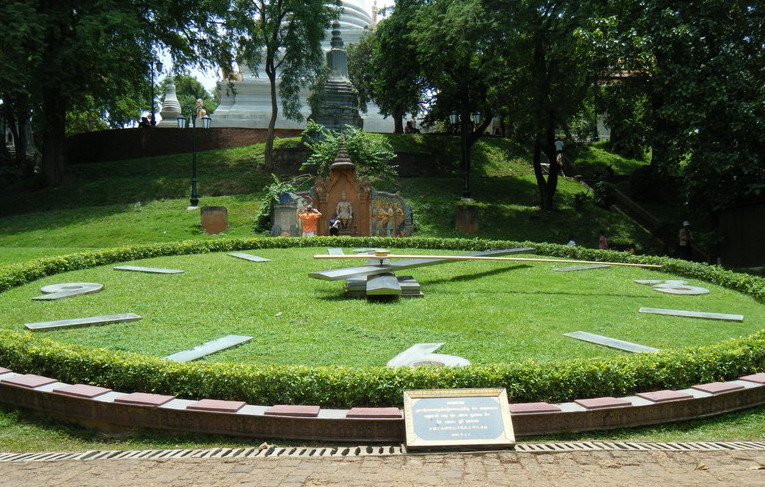
At the base of the hill, on the southern side, a huge clock, illuminated at night, has become one of traffic roundabout, a cluster of European restaurants line the beginning of French Street, purveying fine wine with French and Italian cuisines.

Royal Palace

Royal Palace, located along Sothearos Boulevard, was built in 1866, during the reign of King Norodom. Points of interest inside the palace include:

Prasat Tevea Vinichhay: The hall where Kings and Queens are crowned.
Prasat Khemarin: The hall where the monarchs live.
Prasat Samran Phirum: The hall where the monarchs ride the Royal Elephant.
Hor Baku or Hor Preah Khan: The hall where the throne objects and accessories are kept.

Chan Chhaya: The hall where Royal Dance performers train. In front of the Chan Chhaya, there is a platform where the King can hold audiences with his subjects and all levels of officials.

Royal Palace is the beautiful place in Phnom Penh, and it was in well located (in front of four faces river),Tonle Sap river, Tonle Mekong lour river, Tonle Mekong Krom viver, and Tonle Basak river. moreover, the structure were well build. Every days, there are many tourist visit there.